


Breastfeeding, Breast Cancer, and Breast Health: What You Need to Know

Updated: 5 days ago

Intro
You're in the thick of early motherhood, navigating feeds and sleep schedules and a body that still feels like it's finding its footing. The last thing you want is another item on your mental load. But if a mammogram has been on your mind, or if someone has nudged you to schedule one, here is something worth knowing: breastfeeding does not have to stop you.

Source: Science Direct. Incidence and Mortality Rates for Breast Cancer Globally. 2020.
Breastfeeding and Breast Cancer Risk
One of the quieter pieces of good news in maternal health is this: breastfeeding is associated with a reduced lifetime risk of breast cancer.
According to research recognized by major health organizations including the American Cancer Society, the longer a person breastfeeds over their lifetime, the greater the potential protective benefit.
The reasons are not entirely settled, but researchers believe that hormonal changes during lactation, along with fewer lifetime menstrual cycles, may play a role. This does not mean breastfeeding is a guarantee against breast cancer. It simply means that choosing to breastfeed, when it works for you and your baby, may carry benefits that extend well beyond early infancy.

Here is an interesting fact from the National Library of Medicine:
Mothers and infants both benefit from breastfeeding. Immediate advantages which are experienced by breastfeeding mothers include reduced risk of postpartum depression, postpartum weight loss and lactational amenorrhea. A decreased risk of breast cancer, osteoporosis, type 2 diabetes, rheumatoid arthritis, cardiovascular disease, and ovarian cancer are the benefits that mother receives in the long run. (Mustafa, M. et al., 2024, Introduction Section, para. 4)
Types of Breast Cancer and Staging
Types of Breast Cancer Include: Luminal A type breast cancer, Triple-Negative Breast Cancer (TNBC). Additionally, the more aggressive forms of breast cancer, such as Luminal B type and HER2-enriched BC, Parity Associated Breast Cancer’ (PABC), such as TNBC, BRCA1 mutation-associated breast cancer, PAM50 gene expression assay and classified as one of 4 subtypes, including luminal A, luminal B, HER2 enriched, and basal-like/triple negative.
What the Research Says About Breast Cancer in New Mothers
Breastfeeding itself is protective over the long term, and breast cancer during your childbearing years is still uncommon. But researchers have been paying closer attention, and the emerging picture is worth knowing.
Rates of breast cancer in younger women have been slowly rising, and according to CDC data from U.S. Cancer Statistics, breast cancer incidence among women under 45 increased about 1% per year from 2012 to 2022. The numbers are still small in absolute terms, but the direction is consistent across racial and ethnic groups.
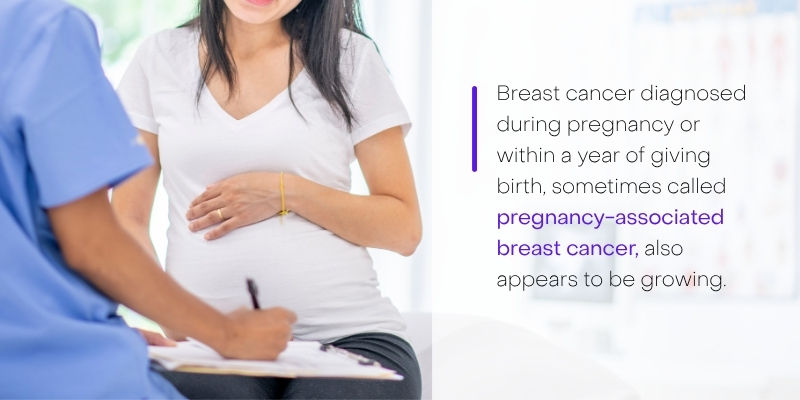
Breast cancer diagnosed during pregnancy or within a year of giving birth, sometimes called pregnancy-associated breast cancer, also appears to be growing. A 2025 systematic review and meta-analysis published in BMC Cancer pooled 22 studies and estimated a global rate of about 19 cases per 100,000 pregnancies, up from roughly 13 cases per 100,000 several decades ago. In Western countries, research suggests that somewhere between 1 in 10,000 and 1 in 3,000 births are affected.

One reason researchers cite for this rise is that more people are having babies later in life. Older age at first birth is a well-established risk factor for breast cancer, and as more first births happen to mothers in their 30s, the overlap between childbearing years and breast cancer years has grown. A 2024 analysis published in BMC Women's Health found that as the average age at delivery rose from 27 to 35, the overlap between the age when people give birth and the age when breast cancer is diagnosed grew by more than 200%.
Researchers are also learning more about postpartum breast cancer specifically, which is cancer diagnosed in the years after delivery. A 2022 study published in JAMA Network Open, led by researchers at Oregon Health & Science University, found that breast cancers diagnosed within five years of giving birth were about 50% more likely to spread to other organs, and more likely to be fatal, compared with cancers in women who had not recently given birth. A separate nationwide study published in Frontiers in Oncology in 2022 followed more than a million women after their first delivery and found that breast cancer incidence climbed steadily year after year in the decade following birth, with cancers diagnosed within five years of delivery carrying a poorer prognosis than those diagnosed later.

None of this is shared to scare you. Pregnancy-associated breast cancer remains rare, and the vast majority of breast changes in new mothers are benign. But it explains why doctors and researchers increasingly encourage awareness during the postpartum months. Your breast tissue is denser and changing quickly right now, which can make a new change harder to notice, and delays in diagnosis are one of the reasons postpartum cancers tend to be found at a later stage. Knowing your own body and being willing to speak up about a change that feels off is one of the most practical things you can do.
Can You Get a Mammogram While Breastfeeding?
Yes. Mammograms are considered safe during breastfeeding. The radiation dose is very low, and it doesn't affect breast milk.

That said, one practical consideration is worth knowing: lactating breast tissue tends to be denser, which can make mammogram images slightly harder to read. Your provider may recommend an ultrasound alongside your mammogram to get a clearer picture. This is a routine and straightforward addition, not a cause for concern. The right imaging approach depends on your history, age, and your provider's guidance. The point is that breastfeeding is not a reason to skip or delay screening.
Practical Tips for Your Appointment
A little preparation goes a long way in making your mammogram more comfortable and more useful.
• Pump or feed just before you arrive. Emptying your breasts before the appointment reduces engorgement, which makes the compression more comfortable and can improve image clarity.
• Tell the technician you are breastfeeding. This is important. Knowing you are lactating helps the radiologist interpret the images accurately and decide whether additional imaging would be helpful.
• Bring what you need. A nursing pad or a small bag for pumped milk can make the experience feel less disruptive to your routine.
When Should You Go?
Follow your provider's guidance on screening schedules. Recommendations vary by age, personal and family history, and other risk factors, and your provider is best positioned to advise you on timing. If you have a family history of breast or ovarian cancer, it is worth mentioning specifically, since it can change what screening makes sense for you.
What matters is this: breastfeeding is not a valid reason to postpone a screening that is otherwise due. If you have been putting it off because you are nursing, you can stop waiting.

Signs to Watch For
Breast changes during breastfeeding are common and usually normal: fullness, tenderness, shifts in size and shape. But some changes are worth bringing to your provider promptly, regardless of whether you are breastfeeding.
Reach out if you notice a new lump or thickening that does not resolve, nipple discharge that is not related to breastfeeding, skin changes such as redness, dimpling, or puckering, or persistent pain in one specific area. Your provider can help you understand what is typical for your body right now and what warrants further attention.

Here are some facts from the American Pregnancy Association:
Continuing with self-breast exams during pregnancy is important. Unfortunately, during pregnancy, it is more difficult to accomplish because of all the changes your breasts are going through. Your breasts are growing in size, are tender, and sometimes may even be lumpy. It is still important for you to examine your breasts during pregnancy every 4-5 weeks.
Very common lumps found among women during pregnancy are clogged milk ducts. These are red, tender-to-the-touch, hard lumps in your breasts. Warm compresses (running warm water over your breasts in the shower or applying a warm washcloth) and massages will probably clear the duct in a few days. If you are unsure of any new lump, tell your doctor on your next visit.
Keep in mind breast cancer is rare among women younger than 35. If you are planning on having a baby and are over the age of 35, you may want to consider asking your doctor about a mammogram before you get pregnant.
(Breast changes during pregnancy, 2020, para. 22-25).
Your Monthly Self-Check
Between appointments, a simple monthly self-check is one way to stay familiar with your breasts. It does not replace a mammogram or a clinical exam, and experts do not agree on how much self-exams change outcomes on their own. They can help you learn what is normal for you, so when something changes, you notice it sooner. That matters more right now than at almost any other time of your life, because your postpartum and breastfeeding body is changing constantly, and a new lump can be easy to miss or easy to explain away.
Here is a simple way to do it. It takes about five minutes.
Start with a look. Stand in front of a mirror with your arms at your sides, then raise them overhead. Look at your breasts directly on, then from each side. Look for any changes from last month: dimpling, puckering, redness, a change in shape or size, or a nipple that has turned inward or looks different.
Then, feel. The easiest time is in the shower or lying down in bed, when your skin is slippery or relaxed. If you are breastfeeding, try right after a feed, when your breasts are emptier and less tender.
Use the pads of your fingers, not the tips. With a gentle, overlapping circular motion, cover the whole breast, from your collarbone down to the bottom of your ribcage, and from your breastbone out to your armpit, where breast tissue and lymph nodes extend. Use light pressure on the surface, medium pressure for the middle layer of tissue, and firmer pressure to feel deep down close to your chest wall.
Gently check your nipple. Look for any discharge, especially if it happens without squeezing, or comes from one spot on the nipple, or is clear or bloody.
Then note how things felt, even if just mentally. The point is not to diagnose anything. It is to build a picture of your normal look, month by month, so that you are the first to know when something shifts.

One tip for making it stick to the calendar: pick a date you will never forget. Dr. Patel does hers on the 13th of every month, because her birthday is the 13th.
Your birthday number works beautifully for this, and so does a child's birthday, an anniversary, or any date that already lives in your memory without effort. Pair it with something you already do monthly, and it quietly becomes a habit.
If you ever find something that concerns you, try not to let fear or a busy week talk you out of getting it looked at. Most changes turn out to be nothing, especially while breastfeeding. But you deserve the reassurance of knowing, and your provider would always rather check something that turns out to be fine than miss something that is not.
More Interesting Facts About Breastfeeding's Correlation to a Lowered Risk of Developing Breast Cancer
Two Facts from The National Library of Medicine:
Breastfeeding for over a year is shown by studies to decrease the risk of invasive breast cancer by approximately 4.3%. All breastfeeding mothers have the risk of developing breast cancer lowered to 11%, while mothers nursing their babies for over a year experience a 26% reduction in breast carcinoma development. Despite the well-known advantages of breastfeeding, breastfeeding rates around the globe remain below recommended levels. Various biological, psychosocial, and social factors contribute to the lack of change in breastfeeding status. Common reasons for discontinuing breastfeeding prematurely include insufficient milk supply, maternal fatigue, and returning to work or school. Socioeconomic factors like a mother’s education, income, and lifestyle also influence breastfeeding.
(Mustafa, M. et al., 2024, Introduction Section, para. 5).
Both exclusive breastfeeding for up to six months and continued breastfeeding accompanied with solid meals, for up to two years, according to the WHO standards, confer great short-term and long-term health benefits for both the child and mother alike. It not only provides cognitive and immune development for the infant, but also prevents the threat of childhood cancers, obesity, sudden infant death syndrome (SID) and respiratory diseases. The immediate, as well as long-term impacts of breastfeeding have significant importance for women health, wellbeing, and survival. Instant effects of breastfeeding show up soon after childbirth, in the form of visceral fat loss and improved metabolic functions. It also serves as a natural contraceptive through inhibited ovulations and ensures uterine health through suckling stimulus derived uterine contractions during breastfeeding, aiding in the removal of fetal components which may otherwise lead to postpartum hemorrhage. Lactation speeds up the reversal of pregnancy-induced metabolic changes and fat accumulation, which would otherwise pose a risk of metabolic diseases, insulin resistance, gestational diabetes, and hypertension.
(Mustafa, M. et al., 2024, Link between duration of breastfeeding and breast cancer Section, para. 34).
Two Facts from the American Academy of Pediatrics:
A recent study of 3,690 black women with breast cancer, however, revealed that those who had breastfed had a lower risk of triple-negative breast cancer, with an OR of 0.81.3 (Breastfeeding and Maternal Breast Cancer Recurrence, 2015, para 6).
Breast cancer is the most common cancer in women.(Breastfeeding and Maternal Breast Cancer Recurrence, 2015, para 5).
You Do Not Have to Figure This Out Alone
Your postpartum body deserves the same care and attention as every other part of new motherhood. Breast health screenings are part of that, and breastfeeding doesn't have to stand in the way.

If you or a loved one would like more resources on this topic or have any other questions, Dr. Sonal Patel can help. Her services are available both nationally and locally in the Denver area. Patients throughout the U.S. can schedule a FREE 20-minute consultation or get their postpartum questions answered 24/7 through our AI Naya Chat.
This post is for informational purposes only and does not constitute medical advice. Please consult your healthcare provider for guidance specific to your situation.
Korey McNulty contributed to this article.
SOURCES
Arnold, M., Morgan, E., Rumgay, H., Mafra, A., Singh, D., Laversanne, M., Vignat, J., Gralow, J. R., Cardoso, F., Siesling, S., & Soerjomataram, I. (2022). Current and future burden of breast cancer: Global statistics for 2020 and 2040. The Breast, 66(66), 15–23. https://doi.org/10.1016/j.breast.2022.08.010
Breast changes during pregnancy. (2020, April 27). American Pregnancy Association. https://americanpregnancy.org/pregnancy/breast-changes-during-pregnancy/
Breastfeeding and Maternal Breast Cancer Recurrence. (2015). AAP Grand Rounds, 34(3), 29. https://doi.org/10.1542/gr.34-3-29
Mustafa, M., Sarfraz, S., Saleem, G., Khan, T. A., Shahid, D., Taj, S., & Amir, N. (2024).
Beyond milk and nurture: Breastfeeding’s powerful impact on breast cancer. Geburtshilfe Und Frauenheilkunde, 84(6), 541–554. PubMed Central. https://doi.org/10.1055/a-2313-0637. National Library of Medicine.


Comments